
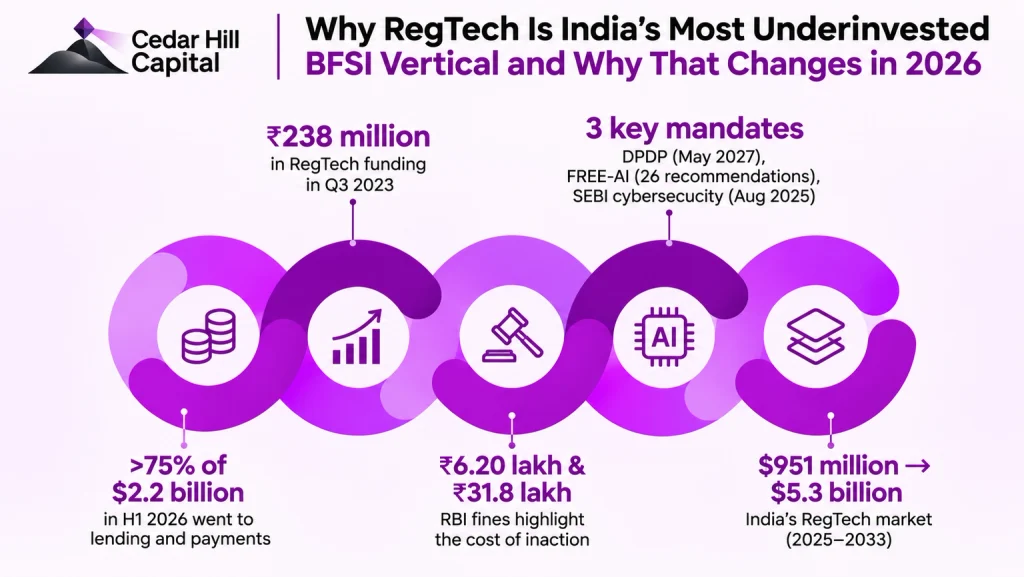
Over the past two years, Indian regulators have tightened rules on data protection, artificial intelligence, and cybersecurity, yet investors have largely overlooked the software that helps institutions comply. India’s RegTech market remains the most neglected BFSI vertical: in H1 2026, lending and payments absorbed more than three-quarters of the $2.2 billion raised by Indian fintechs (Analytics Insight, 2026). That allocation gap is becoming harder to justify.
Why India’s RegTech Vertical Has Been Overlooked by Investors
Investors have traditionally backed products that grow revenue over those that reduce regulatory risk, and the funding record reflects that preference: RegTech raised $238 million in Q3 2023 but nothing comparable a year later (CXOToday, 2024). Yet demand is substantial. India’s RegTech market is valued at $951 million in 2025 and projected to reach $5.3 billion by 2033 (Grand View Research, 2025).
Three Regulatory Mandates Forcing Change in India’s BFSI Compliance Market
Three deadlines are converting compliance technology from discretionary to essential.
Data protection: The DPDP Rules were notified in November 2025, with full compliance required by 13 May 2027 (SS Rana & Co., 2025).
AI governance: RBI’s FREE-AI report sets out 26 recommendations for responsible AI use across the financial sector (Reserve Bank of India, 2024). Advisory today; binding tomorrow.
Cybersecurity: SEBI’s cyber-resilience framework passed its final extended deadline on 31 August 2025, making most regulated entities fully accountable (The Week, 2025).
The Cost of Manual Compliance: What RBI Enforcement Shows
Recent penalties make the cost of inaction visible. In June 2026, RBI fined Five Star Business Finance ₹6.20 lakh for lacking automated transaction-monitoring software (Reserve Bank of India, 2026). In May 2026, Yes Bank was fined ₹31.8 lakh for failing to use the CKYC identifier at onboarding (LiveLaw Business, 2026). The sums are modest; the signal is not.
RegTech’s Next Phase: From Periodic Reporting to Real-Time Supervision
Compliance is moving from quarterly reporting to continuous monitoring. RBI’s MuleHunter.AI, which banks have been asked to adopt, already demonstrates the regulator’s expectation that institutions match its own AI-driven speed (Moneylife, 2026). Products that embed compliance from the first line of code, with explainable decisions and automated audit trails, will become core financial infrastructure. Portfolio companies such as RevRag AI are already building at exactly this intersection, embedding AI-native compliance intelligence directly into BFSI workflows rather than layering it on top. As that happens, RegTech’s status as the most underinvested BFSI vertical will not last, and that is precisely the kind of structural opening our investment thesis was built to find.
Building an AI-native RegTech for India’s financial services market? Apply for funding and tell us what you’re building.