
The legislative work is done. On 27 November 2025, the European Parliament and the Council of the EU reached political agreement on PSD3. Final compromise texts were published in April 2026.¹ Official Journal publication — and the start of an 18-month compliance clock — is expected before the end of 2026.² For B2B FinTechs, that clock is a window, not just a deadline.
What PSD3 Actually Changes for B2B FinTechs
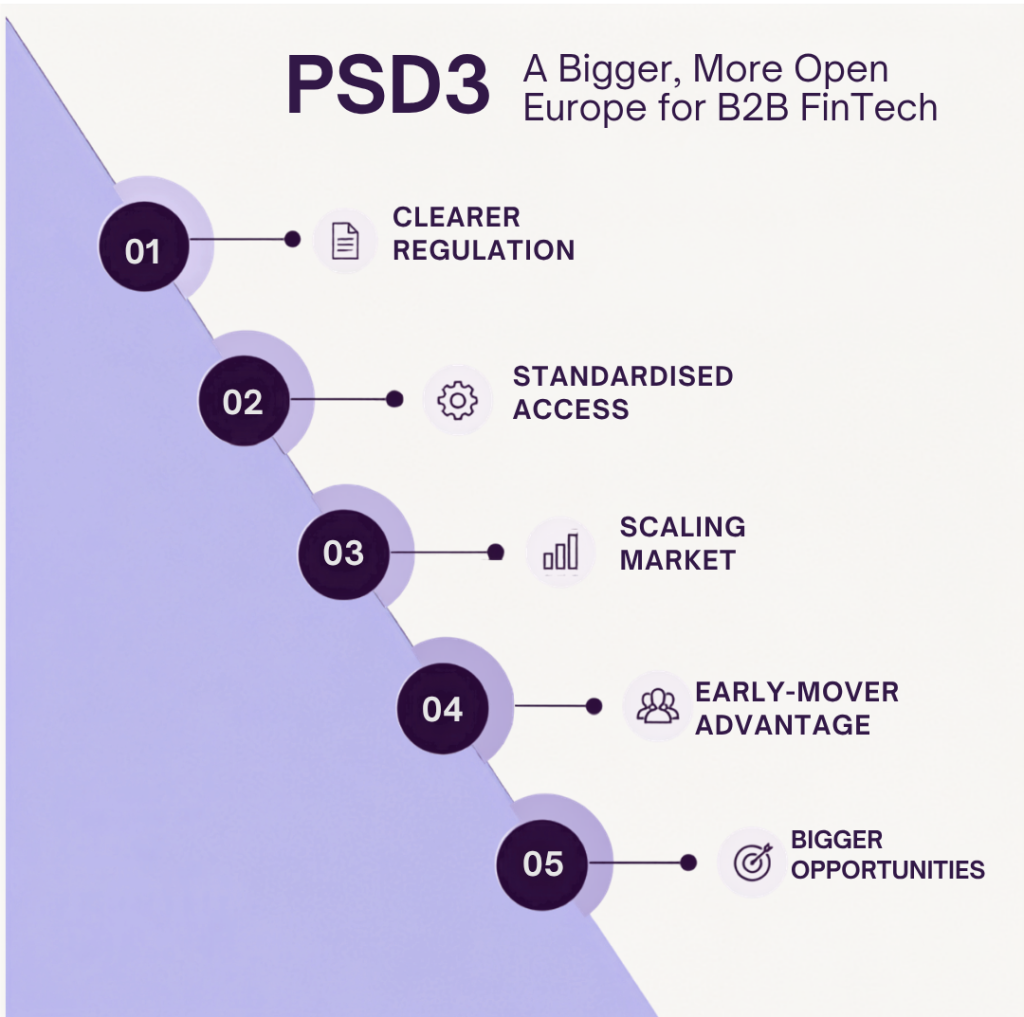
PSD3 replaces PSD2 with a two-part package: the PSR, a directly applicable regulation standardising open banking APIs, fraud liability, and strong customer authentication; and PSD3 itself, which harmonises licensing and supervision across all EU member states.² The critical shift for B2B vendors is standardised, performance-bound API access across the EU — one integration architecture, 27 markets — eliminating the fragmentation that made Europe expensive and slow to enter under PSD2.
Why 2026 Is the Window, Not 2027
Compliance becomes mandatory in late 2027 to mid-2028, once the transition period expires.² But European banks are building their vendor shortlists now, during the transition — not after the deadline arrives. The FinTechs already running pilots when compliance becomes mandatory are the ones that convert to multi-year enterprise contracts. The procurement window opened in 2026. It will not stay open indefinitely.
The Market Is Already Significant
Europe currently holds 34% of the global open banking market.³ The European open banking systems market stood at $11.08 billion in 2025 and is projected to reach $44.55 billion by 2035 at a 15.5% CAGR.³ More than 94% of licensed European banks already participate in open banking ecosystems.⁴ This is not an emerging opportunity — it is a scaling market with active enterprise procurement budgets and a regulatory mandate accelerating every purchase decision.
What Separates the FinTechs That Win This Cycle
The most defensible B2B FinTechs entering Europe will not be those with the best API documentation. They will be the ones who arrive during the transition, earn a reference customer before the compliance deadline, and use that reference to close the next ten. In regulated markets, first-mover advantage is structural. It compounds.
Building an AI-native FinTech with a European expansion plan? Apply for funding and tell us what you are building.