
There is a pattern that repeats in every major enterprise technology wave: adoption intent runs far ahead of production deployment. Agentic AI in Indian financial services is in exactly that phase today. More than 80% of Indian organisations are actively exploring autonomous agents, yet only 23% of organisations globally have scaled an agentic AI system in production (AutomationEdge, 2026). The gap between those two numbers is where the next generation of defensible BFSI FinTechs will be built.
What Makes Agentic AI a Different Bet From What Came Before
Most AI deployed in Indian banks today is reactive: a model that scores credit, flags a transaction, or extracts text from a document. It assists. Agentic AI delegates. An AI agent receives a complex instruction, plans across multiple banking systems, executes multi-step workflows, loan origination, KYC verification, compliance reporting, maintains a full audit trail, and escalates to a human when a threshold is crossed. That is a categorically different capability, not an incremental one.
Why India’s Structural Position Accelerates This Wave
India’s agentic AI moment is a product of converging infrastructure, not just technology hype. The Account Aggregator framework and UPI generate the consent-driven, real-time financial data that agentic systems need to reason over. RBI’s FREE-AI principles — Fairness, Reliability, Ethics, Explainability, Autonomy – provide a governance scaffold that channels deployment toward compliant use cases (Valuebound, 2026). Few markets combine the data infrastructure and regulatory clarity to accelerate agentic deployment in BFSI simultaneously.
The Three Verticals Where Agents Are Landing First
Based on Cedar Hill Capital’s deal pipeline, agentic AI is finding repeatable enterprise traction in three places: credit operations (loan origination, document extraction, underwriting decisions), compliance automation (KYC, AML, regulatory reporting), and fraud intelligence (real-time, cross-channel transaction monitoring). EY has documented a 50% reduction in AML investigation time per case using agentic systems — the kind of ROI that converts pilot approvals into multi-year contracts (LatentView, 2026).
What This Means for the Investment Thesis
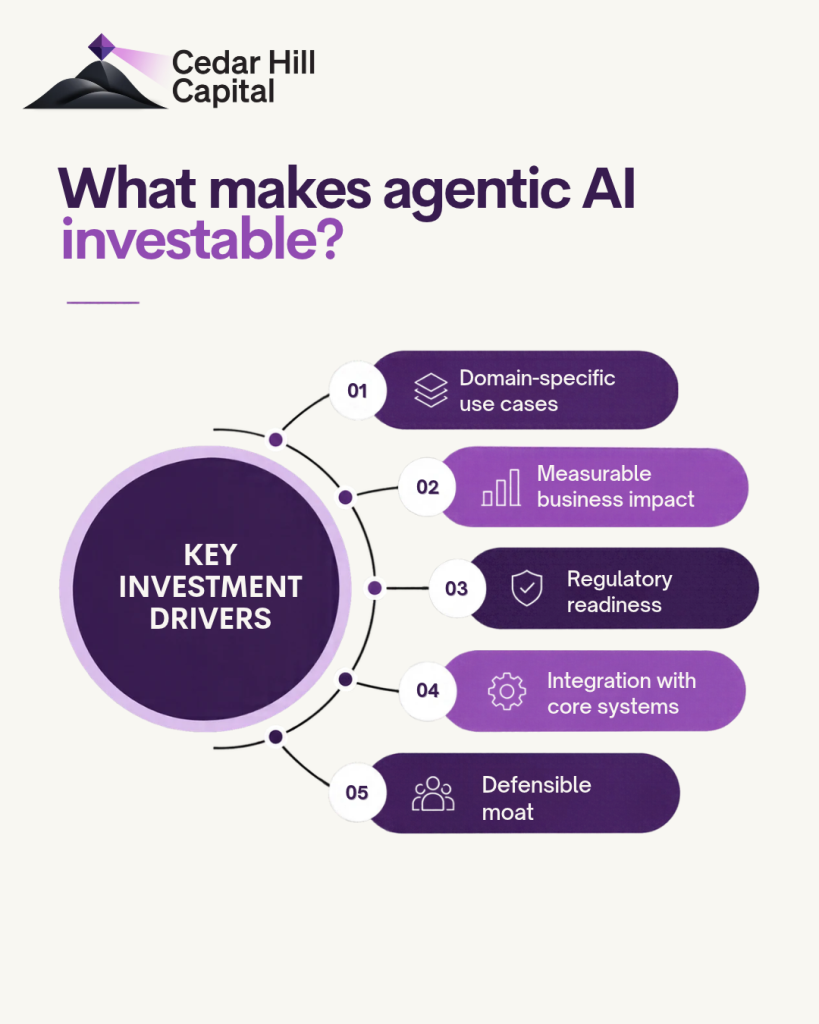
The global agentic AI market is projected to grow from $9.14 billion in 2026 to $139 billion by 2034 at a 40.5% CAGR (Hostinger, 2026). The investable opportunity within that curve is not the horizontal agent platform – it is the vertical, domain-specific agent built for the workflows where Indian banks actually spend money: credit, compliance, and fraud. The founders who understand that distinction and build accordingly will produce the most defensible companies of this decade.
Building an agentic AI FinTech for India’s financial services market? Apply for funding → and tell us what you’re building.